

How To Bomb The Us Govt
Flop threats or suspicious items should always be taken seriously. How quickly and safely you react to a bomb threat could relieve lives, including your own. What should you do?
The guidance and resources listed below outline in-depth procedures for either flop threats or suspicious items and will help you prepare and react appropriately during these events.
If You Receive a Flop Threat
Bomb threats are near unremarkably received via phone, just are besides fabricated in person, via email, written note, or other means. Every bomb threat is unique and should exist handled in the context of the facility or environment in which information technology occurs. Facility supervisors and police enforcement volition be in the best position to determine the credibility of the threat. Follow these procedures:
- Remain calm.
- Notify government immediately:
- Notify your facility supervisor, such equally a managing director, operator, or ambassador, or follow your facility'due south standard operating process. (Come across beneath for aid with developing a plan for your facility or location.)
- Telephone call 9-1-1 or your local law enforcement if no facility supervisor is bachelor.
- Refer to the DHS Bomb Threat Checklist for guidance, if available.
- For threats made via telephone:
- Keep the caller on the line as long equally possible. Be polite and show interest to keep them talking.
- Do NOT HANG Upwardly, even if the caller does.
- If possible, signal or pass a annotation to other staff to listen and help notify authorities.
- Write down as much data every bit possible—caller ID number, exact wording of threat, blazon of voice or beliefs, etc.—that will aid investigators.
- Record the call, if possible.
- For threats made in person, via email, or via written note, refer to the DHS Flop Threat Checklist and DHS-DOJ Flop Threat Guidance for more information.
- Be available for interviews with facility supervisors and/or police enforcement.
- Follow authorities' instructions. Facility supervisors and/or law enforcement will appraise the situation and provide guidance regarding facility lock-down, search, and/or evacuation.
Watch the Bomb Threat Preparation Video beneath and refer to the DHS-DOJ Bomb Threat Guidance for more information.
If You Find a Suspicious Particular
Together nosotros can aid keep our communities safe—if you see something that is suspicious, out of place, or doesn't look right, say something. (Find out more than about the "If Yous See Something, Say Something®" entrada.) A suspicious item is any item (e.g., handbag, package, vehicle, etc.) that is reasonably believed to incorporate explosives, an improvised explosive device (IED), or other hazardous cloth that requires a bomb technician and/or specialized equipment to further evaluate it. Examples that could indicate a flop include unexplainable wires or electronics, other visible bomb-like components, and unusual sounds, vapors, mists, or odors. Mostly speaking, annihilation that is Hidden, Obviously suspicious, and non Typical (HOT) should be deemed suspicious. In addition, potential indicators for a bomb are threats, placement, and proximity of the item to people and valuable assets.
For more information on recognizing suspicious items, reference the Unattended vs. Suspicious Postcard and Poster, and view the video "What to Do: Suspicious or Unattended Item."
Note: Non all items are suspicious. An unattended item is an item (e.k., bag, package, vehicle, etc.) of unknown origin and content where there are no obvious signs of being suspicious (see above). Facility search, lock-down, or evacuation is not necessary unless the particular is adamant to be suspicious.
You may encounter a suspicious detail unexpectedly or while conducting a search as part of your facility'due south or employer'south Bomb Threat Response Plan. If it appears to be a suspicious item, follow these procedures:
- Remain calm.
- Practise Not touch, tamper with, or motility the package, bag, or item.
- Notify authorities immediately:
- Notify your facility supervisor, such as a managing director, operator, or administrator, or follow your facility's standard operating process. (Encounter below for assistance with developing a program for your facility or location.)
- Phone call ix-one-1 or your local law enforcement if no facility supervisor is available.
- Explain why it appears suspicious.
- Follow instructions. Facility supervisors and/or law enforcement volition appraise the situation and provide guidance regarding shelter-in-place or evacuation.
- If no guidance is provided and you feel you are in immediate danger, calmly evacuate the surface area. Distance and protective encompass are the best means to reduce injury from a bomb.
- Be aware. There could be other threats or suspicious items.
Every situation is unique and should be handled in the context of the facility or environment in which it occurs. Facility supervisors and police force enforcement volition be in the best position to determine if a real hazard is posed and how to respond. Refer to the DHS-DOJ Bomb Threat Guidance for more information.
Have a Plan - Guidance for Facility Owners, Operators, and Managers
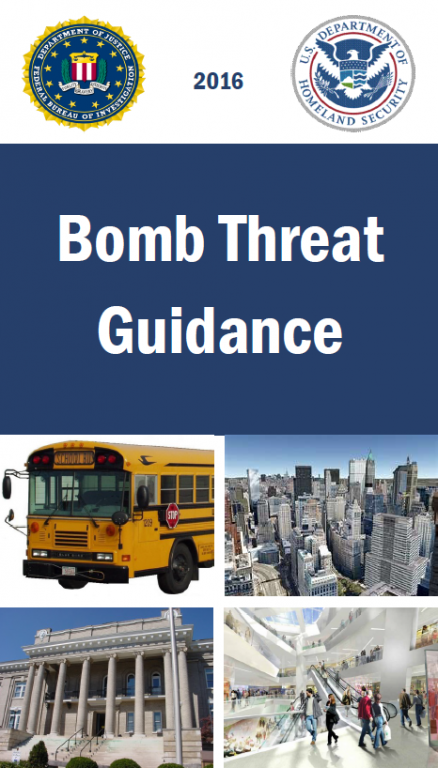 Having a programme in advance makes the response to bomb threats, unattended items, or suspicious items as orderly and controlled every bit possible, reducing risk and the impact of fake alarms on regular activities. Facility supervisors—such every bit school, office, or building managers responsible for the facility—should:
- Review the DHS-DOJ Flop Threat Guidance.
- Develop a Bomb Threat Response Programme for their system or facility. Contact the Role for Bombing Prevention at OBP@cisa.dhs.gov for more information on planning workshops.
- Train employees, tenants, and/or visitors to have appropriate actions in the consequence of a bomb threat and/or identification of an unattended or suspicious item.
Developed in partnership with the Federal Bureau of Investigation, the Department of Homeland Security (DHS)-Department of Justice (DOJ) Bomb Threat Guidance is a quick reference guide that provides facility supervisors with details on pre-threat preparation, threat cess, staff response guidelines, and evacuation and shelter-in-place considerations. Download the DHS-DOJ Flop Threat Guidance for more data.
Flop Threat Checklist
Whether the bomb threat is made via telephone, handwritten note, electronic mail, or other ways, the DHS Bomb Threat Checklist provides instructions on how to respond to a flop threat and a comprehensive list of information that volition assist law enforcement in a flop threat investigation.
- Print this checklist for your business, organization, or facility to use in case of a flop threat.
Bomb Threat Grooming Videos
Information technology'due south important to know what steps every twenty-four hours citizens can and should take in the issue of a flop threat. The "What to Do: Bomb Threat" video, adult by the University of Primal Florida, in conjunction with the International Clan of Chiefs of Police (IACP) and the Role for Bombing Prevention inside the Cybersecurity and Infrastructure Security Bureau'south Infrastructure Security Partition, teaches viewers how to respond in the event they receive a bomb threat.
Download and impress the Department of Homeland Security (DHS) Bomb Threat Checklist used in this video.
For more than data on how to recognize bomb threats and react appropriately, view these other "What to Exercise" Videos:
- "What to Practice: Suspicious or Unattended Particular": Demonstrates how you can determine whether an item is suspicious (potential bomb) or simply unattended and will help you ready and react appropriately
- "What to Do: Bomb Searches": Describes basic bomb search procedures to use one time the determination has been made that a search is warranted and authorities have been notified. This video demonstrates in particular, the room, route, and area search techniques that can be practical to any type of facility.
- "What to Do: Surviving a Bombing Assail": Describes what happens when a bomb detonates and demonstrates the procedures you should follow to survive a bombing attack.
Download the printer-friendly Training Series Video Fact Canvas.
Mass Bomb Threat Campaigns
Mass bomb threat campaigns are a reminder that bomb threats pose a serious disruption within local communities, as well as to public and individual sectors across the United States. They have psychological bear on, disrupting lives and creating fear, uncertainty, and sometimes panic. With multiple threats to similar targets, the psychological and operational affect can exist increased. They have an operational impact - causing activities to halt, harming commerce, and draining the resource of law enforcement and other first responders. Electronically disseminated mass flop threats can target specific types of infrastructure on a national level (election polling locations, institutions of higher didactics, medical facilities, etc.) to heighten the impact and create cascading consequences. Mass bomb threats typically lack specificity or make thousand claims (i.eastward. "there is a flop in every major city"). Threats are typically sent past electronic mail or telephone and calls may use an automatic voice. Unsubstantiated bomb threats may also create complacency that can lead to increased vulnerability when bodily devices are present.
The Mass Flop Threats Postcard provides awareness on mass bomb threat campaigns illustrating their impacts and indicators forth with a focus on evaluating run a risk levels and threat response options.
Our TRIPwire Sensation Bulletin titled "Responding to Mass Bomb Threat Campaigns" provides resources for a managed response to flop threat campaigns; data on previous mass flop threat campaigns; and statistics on devices discovered following flop threats. Download the printer-friendly Mass Bomb Threats TRIPwire Awareness Bulletin.
Additional Resources for State and Local Constabulary Enforcement, First Responders, and Private Sector Security
If you take an official office in planning for or responding to flop threats, these specialized programs, products, and information may exist useful to you.
Bomb Prevention Planning
The Section offers planning resources and workshops to help jurisdictions understand the IED risk and how to comprise effective counter-IED risk mitigation practices into preparedness planning. Our guides and programs aid with collectively identifying roles, responsibilities, capability gaps, and how to optimize express resource within a planning area.
Flop Prevention Grooming
DHS provides a variety of counter-improvised explosive device (IED) trainings and develops counter-IED products for law enforcement, commencement responders, and the individual sector to raise the security and resilience of the Nation.
OBP also maintains catalogs of counter-IED preparedness training and education resources that are provided directly by the federal government or are federally sponsored. These catalogs are available for both private sector and state, local, tribal, and territorial (SLTT) partners:
- The Itemize of Federally Sponsored Counter-IED Training and Educational activity Resource for Private Sector Partners
- The Catalog of Federally Sponsored Counter-IED Training and Teaching Resources for State, Local, Tribal, and Territorial (SLTT) Partners
TRIPwire
The Technical Resource for Incident Prevention (TRIPwire) is the Department of Homeland Security'south 24/7 online, collaborative information-sharing and resource portal for evolving IED tactics, techniques, and procedures, as well as lessons learned, for:
- Flop squads
- Emergency responders
- Military machine personnel
- Government officials
- Intelligence analysts
- Individual sector security professionals
- Critical infrastructure owners and operators
Contact Information
To report suspicious activity, call 9-1-one or contact local law enforcement.
Delight contact your local Protective Security Advisor (PSA) or send an email to the Office for Bombing Prevention (OBP) at OBP@cisa.dhs.gov for boosted information about OBP products and programs, or to schedule a preparation session or a planning workshop.
Informed, alert communities play a critical role in keeping our nation safe. Everyone has a responsibility to protect our nation—"If You See Something, Say Something®."
Source: https://www.cisa.gov/what-to-do-bomb-threat
0 Response to "How To Bomb The Us Govt"
Post a Comment